03 · Filler
Filler Harmonizing
Filler is usually the last tool I reach for, not the first. When we do use it, we use a little, in the right plane, to support what your own skin and collagen are already doing.
What it is
The clinical, plainly stated.
Filler is three-dimensional volume restoration. We rebuild the scaffolding underneath the skin where bone and fat pads have quietly receded. It is the opposite of chasing wrinkles.
I am cautious here on purpose. People walk in with filler phobia for a reason. Done well, it reads as 'you, rested.' Done poorly, it reads as pillow face. Most of the time I would rather build your collagen with Sculptra or PRF first and add a small amount of filler later, only where it is needed.
Done well, the difference is anatomy. Where the product sits, what plane it sits in, and how much of it actually goes in versus how much we resist.
Zone breakdown
How I think about the face.
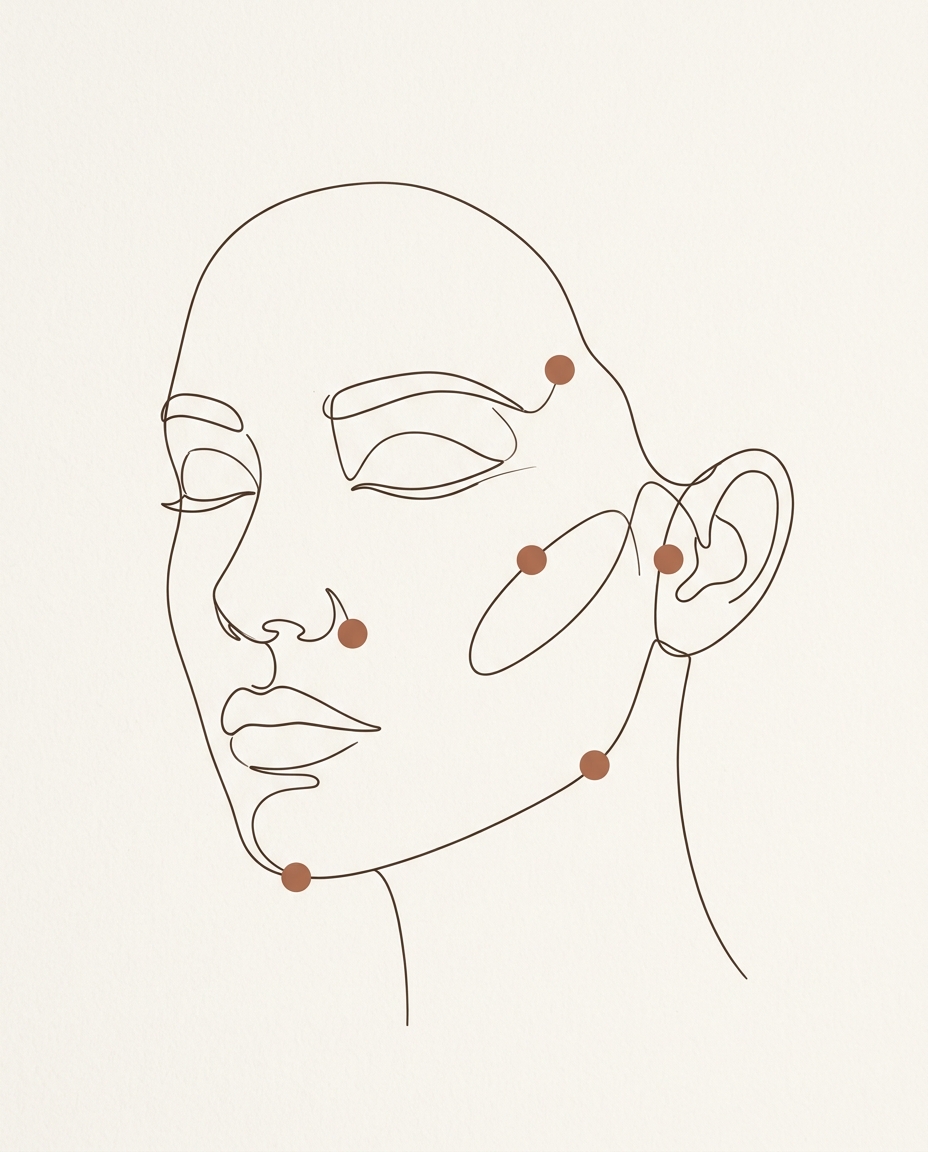
I plan zone by zone. Below are the regions I most often treat as part of a harmonizing plan, almost no one needs all of them, and very few need them on the same day.
Temples
01Reverses the hollowing that pulls the lateral brow down and ages the upper third quietly.
Cheeks (zygomatic)
02Restores the high convex curve. Lifts the lower face from above, instead of stretching it from below.
Preauricular
03The bridge between temple and cheek. Filling it prevents the 'plugged' look you see when cheeks are treated in isolation.
Piriform
04A small, precise placement that softens the nasolabial fold from underneath and supports the medial cheek and corner of the mouth.
Nasolabial folds
05Treated indirectly, lifted by piriform and lateral cheek support, almost never injected directly.
Gonial angle / jawline
06Frames the lower face and restores the separation between jaw and neck. Useful in both younger jaw definition and mature jaw restoration.
Chin
07Improves projection and anchors the lower third. A small change here often makes the rest of the face look more balanced.
Typical plan
A typical harmonizing plan is four to eight syringes over one to three sessions. The first session usually covers temples, cheeks, and chin foundation. A second session refines piriform and jaw. Maintenance is one or two sessions a year.
Ideal candidate
Who I treat, and who I send back.
Early-to-moderate volume loss, the 'I look tired even when I'm not' feeling.
Wants subtle restoration, not a transformation.
Comfortable with a staged build over weeks, not chasing a one-day fix.
Wants face-wide harmony, temples, cheeks, jaw, chin, not single-spot patches.
What to expect
The visit, start to finish.
- 01
Photo mapping
Multiple angles, neutral light. We mark anatomical landmarks together. Ten to fifteen minutes.
- 02
Cleanse + plan on the face
I draw the plan directly on the skin so we're agreed on placement before anything goes in.
- 03
Inject
Linear threading, crosshatching, and depot techniques placed on bone and into fat-pad planes. Twenty to forty minutes.
- 04
Reassess
Sit you up, mirror, photos again. We decide whether anything needs a touch more or whether we're stopping here. Total visit is 45 to 75 minutes.
Results timeline
When you'll actually see it.
Day 0
Immediate volume and some swelling. You will not look final today.
Day 3–5
Mild swelling peak. Bruising shows itself if it's going to.
Week 2
Settled and final-ish. Photos at this point are honest.
Month 1–3
Product integrates. A subtle collagen response builds underneath.
Month 3–6
The 'you, rested' window. Best photos live here.
Month 9–12
Softening begins. Most clients touch up around this point, usually one or two syringes.
Aftercare
The first 24–48 hours.
Boring instructions that quietly determine how good your result looks at week two. Don’t skim them.
- 01
No touching, pressing, or massaging the treated areas for 24 hours.
- 02
Skip strenuous exercise, sauna, and hot yoga for 48 hours.
- 03
Sleep elevated for two to three nights.
- 04
Arnica is fine. Ibuprofen if it's not contraindicated for you. Heavy blood thinners get a 24–48 hour pause if your prescriber agrees.
- 05
Skip retinoids, acids, and active vitamin C for 48 hours.
FAQ
The questions I get most.
Will I look 'done'?
Not if we go slow. The goal is 'you look rested,' not 'you got fillers.' Most of my filler work is invisible to the people in your life, they just notice you look well.
How often will I need it?
Every nine to twelve months for most people. Some go twelve to eighteen. Annual is a reasonable rhythm to plan around.
How is this different from a facelift?
A facelift removes skin and tightens the SMAS layer, it's surgical, irreversible, with real recovery. Filler restores volume non-surgically, is reversible if HA, and has essentially no downtime. They solve different problems and they coexist well.
What if I don't like the result?
HA filler is dissolvable with hyaluronidase. Most clients fall in love with the two-week settled result, but the safety net is real.
Will filler make a future facelift harder?
No. Filler sits above the surgical plane. Many of my clients eventually do both, years apart.
Should I combine it with Botox?
Often, yes. Volume restores the architecture; toxin quiets the muscles that pull on it. Working both together is usually a smarter plan than either one alone.
Honest risks & contraindications
What can go wrong, and where we say no.
Filler is one of the most rewarding tools I have, and also one of the most over-used. Here's what we screen for, and where I will say no.
Common + expected
- ·Bruising and swelling for a few days.
- ·Tenderness and mild firmness as the product integrates.
- ·Occasional small lumps in the first one to two weeks.
Serious, uncommon but real
- ·Persistent nodules, uncommon, usually placement-related, manageable.
- ·Infection, rare, treated promptly.
- ·Vascular compromise, rare but the reason injector training matters. Hyaluronidase is on hand, always.
We don’t treat if
- ·Pregnancy or breastfeeding.
- ·Active facial infection.
- ·History of anaphylaxis to filler components.
- ·Severe immunosuppression.
- ·Active body dysmorphia, we postpone, we don't refuse the person.
- ·Cold sore history without preventive antivirals.
- ·On significant anticoagulation, bruising risk gets discussed openly.
Ready when you are